Oct 7, 2026 · 1 min read
Self-Hosted MongoDB or Atlas? You're Really Choosing Who Fights the 3 AM Fire
Picking between self-hosted MongoDB and Atlas isn't a database decision. It's a decision about who handles operations at 3 AM. Here is the honest breakdown.

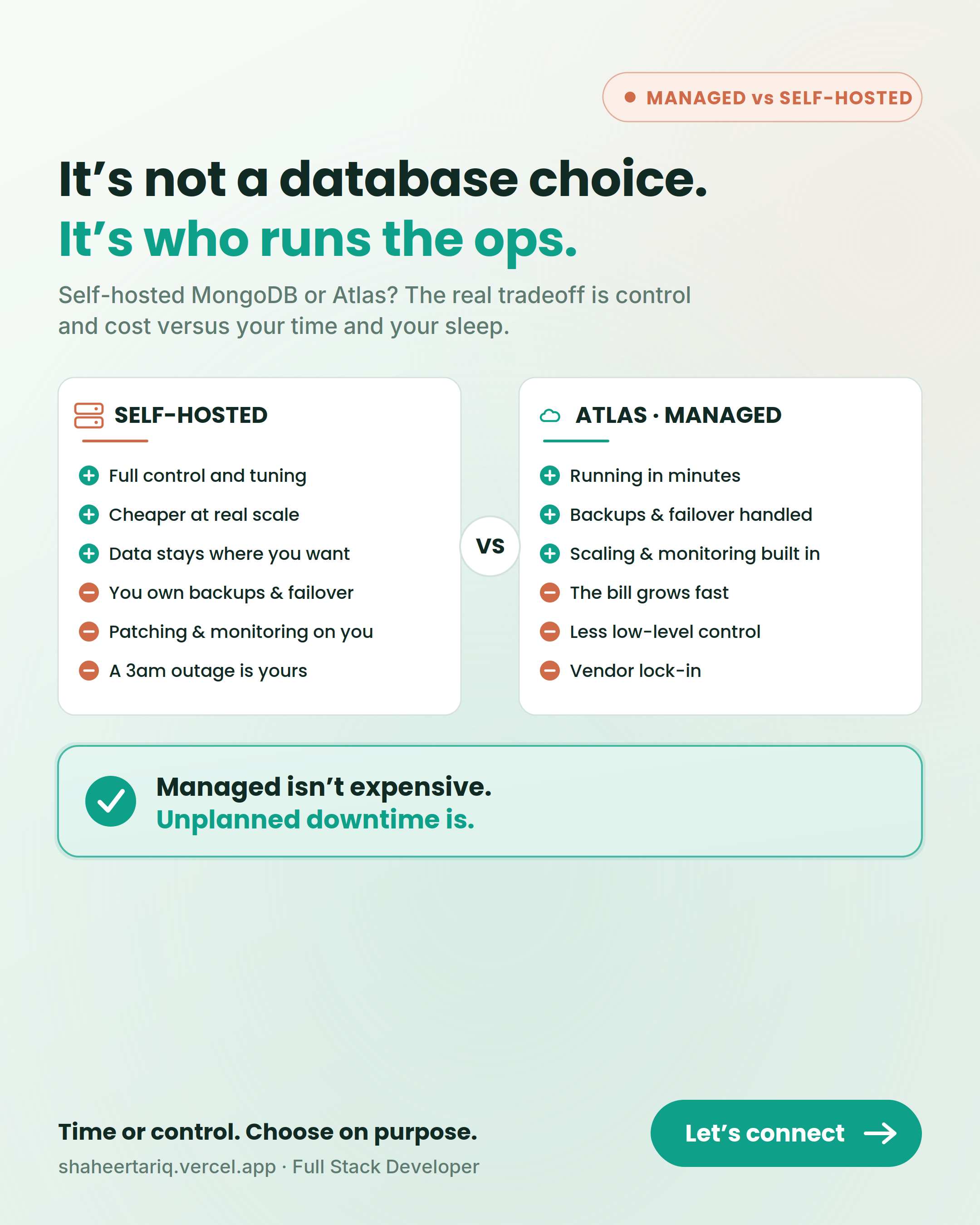
Self-hosted MongoDB or MongoDB Atlas?
You are not really choosing a database. You are choosing who handles the operational fires at 3 AM.
Here is the honest breakdown.
MongoDB Atlas (managed)
Pros: Fast setup, automated backups, built-in security, auto-failover, and seamless scaling. You are running in minutes and most of the operational work is handled for you.
Cons: Costs scale quickly, data-transfer fees add up, and you lose low-level OS control. Some tuning simply is not yours to do.
Self-hosted MongoDB
Pros: Full infrastructure control, predictable costs at scale, zero vendor lock-in, and strict data-residency compliance when you need it.
Cons: You own every backup, every security patch, and every 3 AM primary node failure. It requires real, dedicated ops expertise.
The rule of thumb
Early stage or fast iteration: Go with Atlas. Your engineering time is worth more than the subscription bill, and not getting paged is a feature.
Heavy scale, in-house ops, or strict compliance: Go self-hosted. At that point you have the people to run it well, and the cost savings justify the operational overhead.
The trap
The trap is picking self-hosted to save money without factoring in engineering hours. That "cheaper" price tag quietly includes a lot of your own time: setup, monitoring, patching, and disaster recovery.
Managed databases are not expensive. Unplanned downtime is.
Your turn
Both choices are valid. The mistake is choosing on sticker price instead of total cost, including the hours you will spend keeping it alive.
Which setup are you running in production, and would you choose it again?