Oct 14, 2026 · 2 min read
How One Slow API Used to Take Down My Entire Backend
A single unreliable third-party API could crash my whole application. Here is how I redesigned the system around blast radius so one failure stays one failure.

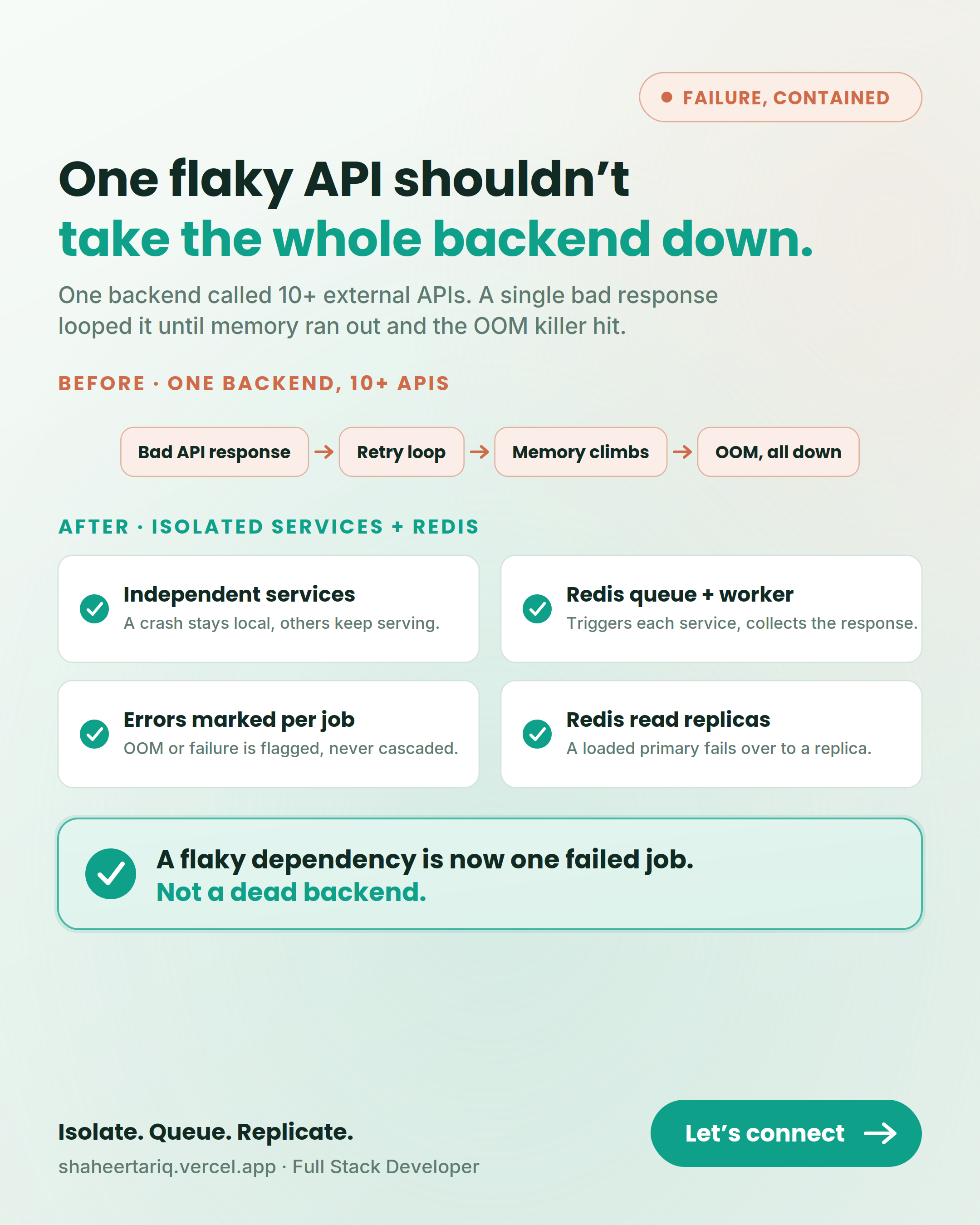
One slow third-party API used to bring down my entire backend. Here is how I redesigned the system to prevent it.
While working on a platform that integrated with 10+ external APIs, I ran into a reliability problem that completely changed how I approach backend architecture.
The system worked well under normal conditions. But when a third-party API became slow or returned unexpected responses, things started to break. Requests would retry repeatedly. Memory consumption would climb. Eventually the OOM killer would terminate the backend process.
One unreliable dependency could bring down the entire application.
The real problem was not the external API. Every system has flaky dependencies. The real problem was how tightly coupled everything had become, so one bad actor could drag the rest down with it.
Here is how I approached the redesign.
1. Isolated the third-party integrations
I moved each platform integration into its own independent service, separating their execution and their resource usage. Now a failure in one integration does not automatically affect the others. A crash stays local.
2. Introduced Redis-based job queues
Instead of running long external API calls directly inside incoming requests, I moved them to asynchronous processing. Workers pick up jobs, run the relevant integration, and record the result.
If an integration fails, the job is marked as failed without taking down the backend. The request that triggered it is no longer hostage to a slow third party.
3. Improved failure handling
I added proper failure isolation and job-level error handling, so unexpected responses, timeouts, and service crashes are caught and recorded instead of cascading into unrelated operations.
4. Scaled the coordination layer
I introduced a Redis read replica to distribute eligible read workloads and reduce pressure on the primary instance. As the platform grew, that kept the coordination layer itself from becoming the bottleneck.
The outcome
Before:
One failing API → repeated retries → increasing memory usage → backend outage.
After:
One failing API → isolated job failure → other services keep operating.
The real lesson
The biggest thing I learned was not about microservices or Redis specifically. It was about reducing the blast radius of failure.
In distributed systems, failures are inevitable. The goal is not to eliminate every failure. It is to design systems where one failure does not cascade into a complete outage.
Reliability is not just about keeping services running. It is about designing them independently.
For engineers working with multiple third-party integrations: how do you stop a slow or unreliable dependency from taking down the rest of your system?